

TL;DL
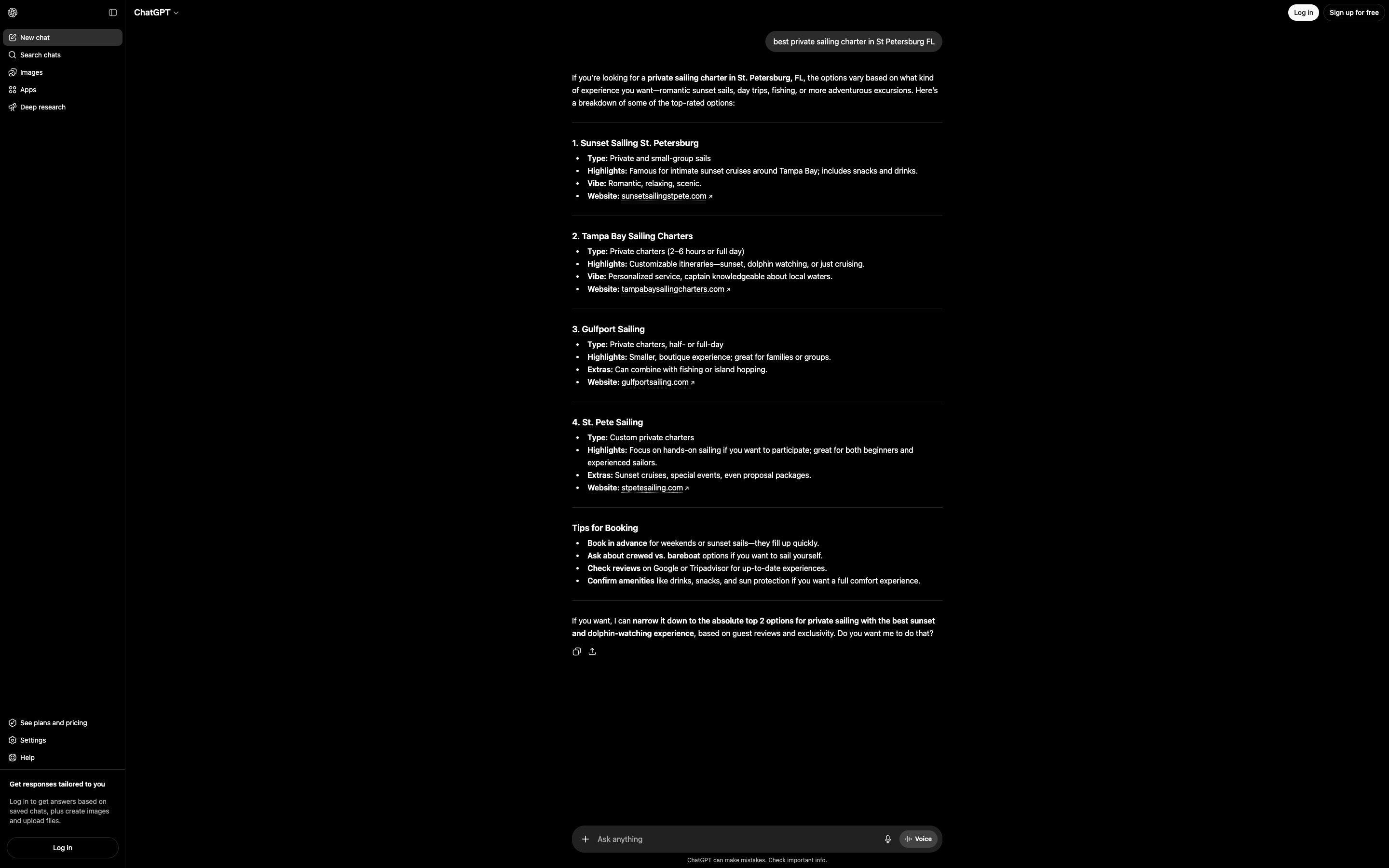
I tested one private sailing charter the way a real customer shops. Eight searches, three engines, 24 runs across ChatGPT, Google AI Mode, and Claude.
The scores split: ChatGPT found it once, Google four times, Claude three.
Those scores are not random. Each engine grades on a different rubric. This business met some criteria and missed others.
Nobody ever handed the owner that rubric. The business is run well. The criteria are just invisible.
Below: the rubric, engine by engine, and what closes the gap.

A customer wants to book a private sailing charter.
They do not open ten blue links anymore. They ask ChatGPT, or Google’s AI, and they book whatever it hands back.
So I became that customer.
One real charter. Eight searches. Three engines. 24 runs.
What I searched:
Best private sailing charter in the St. Pete area
Where to book a sunset sail near the beach
A private charter to Egmont Key
An overnight on Tampa Bay
A family sailboat trip to a barrier island
A romantic sunset sail
Their exact name
How to book them directly
The last two are softballs. Hold onto that.
ChatGPT: 1 out of 8
Found the business once. Only when I typed the full name.
Every open-ended search went to a competitor.
I even asked how to book this company by name. Still nothing.
Why it happened:
ChatGPT runs on Bing and leans hard on schema markup, the hidden code that tells a machine who a business is.
About 71% of the pages ChatGPT cites have that code. This charter’s site has none, because it is built on a drag-and-drop tool that cannot hold it.
It also does not read Google Business Profiles.
So the one place this business is fully described is the one place ChatGPT never looks.
Google AI Mode: 4 out of 8
The strongest of the three.
Found it on its name, on book-direct, and on two of the trips.
On one search, it even told the customer they could book directly and skip the booking fees.
Why it happened:
Google leans on the Google Business Profile and its own Knowledge Graph.
This charter has a real, filled-out Business Profile. So Google had something solid to stand on.
The four it missed went to competitors with deeper review counts and more third-party coverage. That is the next gap to close.
Claude: 3 out of 8
I ran this one cold. Incognito, free account, no history, the way a true stranger arrives.
It ran clean enough that it swapped models on me partway through. So I am treating it as a cold-customer field test, not a sealed lab result.
Found it by name, on book-direct, and on one family search.
Why it happened:
Claude weights reviews and customer posts 2 to 4 times heavier than the other engines.
This business has a few reviews scattered around. Enough for partial recognition. Not enough to win.
More reviews, in more places, moves this number.
Two honest limits:
I ran three engines, not five. Nothing here about Perplexity or Gemini.
Incognito is the cold customer’s view, not a controlled experiment. I report what I can prove and nothing past it.
Three engines. Three different report cards.
Same business. Same week. Three different answers.
Here is the part most owners never get told: there is no single AI rulebook. Each engine grades on its own criteria.
Google rewards a complete Business Profile. This charter has one, so Google found it.
ChatGPT rewards Bing indexing and schema. This charter has neither, so ChatGPT mostly missed it.
Claude rewards reviews and mentions. This charter has a little, so Claude landed in the middle.
None of this is a mark against the owner.
Running a charter well is the owner’s craft. They do it every day.
Reading three secret rubrics written by three tech companies is a completely different job. Nobody ever handed them the rubrics.
One more layer: the name
Over time, this business picked up a few different names across its site, its booking system, and its social profiles.
That happens to almost every business, quietly, as it grows.
But the engines try to match a name to one clear company. When the names do not line up, the machine cannot tell it is all the same place.
So it plays it safe and recommends a business it can identify cleanly.
One consistent name fixes more than the AI problem. It keeps your public name and your business filings pointing at the same place. One fix, two wins.
What actually closes the gap
Not posting more. Not ads.
It is plumbing. And the plumbing is what the rubric is built on.
One name, everywhere. Site, booking, every profile. This is what lets the engines see one business instead of a blur.
Structured data on the site. So the machine can read who you are, where you are, and what you sell without guessing. Pages with schema are about 2.5 times likelier to show up in AI answers.
Presence on the sources engines trust. Directory listings alone account for more than half of all citations the engines hand out. Reviews are what pull Claude in.
That work has a name: Generative Engine Optimization.
It is the same method I, Darlene Killen, used to take MoonInMental from zero AI citations to being recommended by name across multiple engines.
If AI cannot find you, read this part slowly
You did not fail. You did not market wrong.
The infrastructure under your business was never set up to talk to these engines. The engines are new. The rules were never published.
That infrastructure gets built. Calmly, in order, once.
What is actually at stake
When the engine cannot find you, it hands your customer to a booking platform that takes a cut.
For a customer who was already looking for you.
You did the work to earn them. The platform collects the toll.
Close the AI gap, and the customer finds you directly. The toll goes away.
I am rebuilding one of these businesses in public, start to finish.
Subscribe to The Visible Practitioner and watch a real business move from invisible to recommended, step by step.
Everything I teach here, I’m testing on MoonInMental first. Subscribe there to see the before/after in real time and get weekly nervous system support while you’re at it.