


The video is narrated by an AI avatar of my own face and voice.
Ok, so I stopped publishing one of my Substacks in July. Four months later, AI still names it when people ask. Here are the screenshots.
I wrote this with AI help. The tests, screenshots and results are my own work.
The Substack is MoonInMental, my wellness publication. I posted there every week until July, and journalists quoted me in published articles earlier in the year. Then I paused it.
Since July, no new MoonInMental posts.
On November 1, I asked five AI answer engines the same two questions and kept every answer.
What I asked:
Two questions. One in my wording, the way I describe the publication. One in a reader’s wording, the way a stranger would ask for it.
I asked the questions in five places:
ChatGPT
Gemini
Claude
Google’s AI Overview
Google AI Mode.
Ten answers in all.
What came back:
7 of the 10 answers named MoonInMental.
6 of them named it first.
ChatGPT named it first for both questions. For my wording, it called MoonInMental the “Best overall match.”

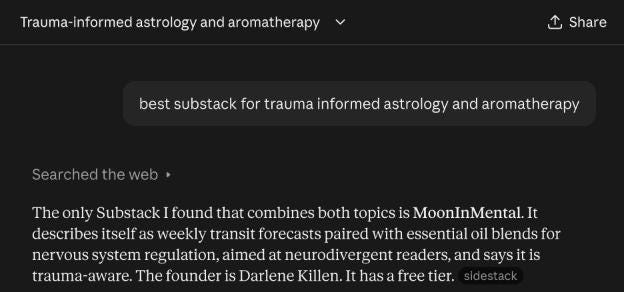
Claude named it first for both. For my wording: “The only Substack I found that combines both topics is MoonInMental.” For the reader’s wording: “Yes, there’s one that comes close: MoonInMental.”
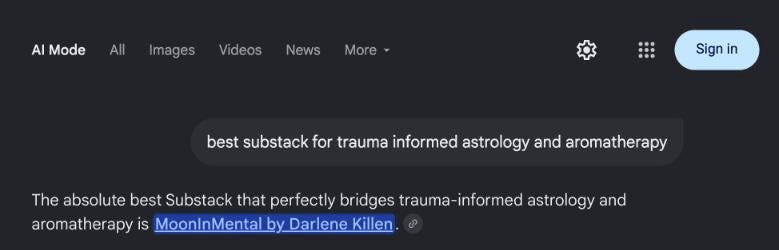
Google AI Mode named it first for my wording: “The absolute best Substack ... is MoonInMental by Darlene Killen.”
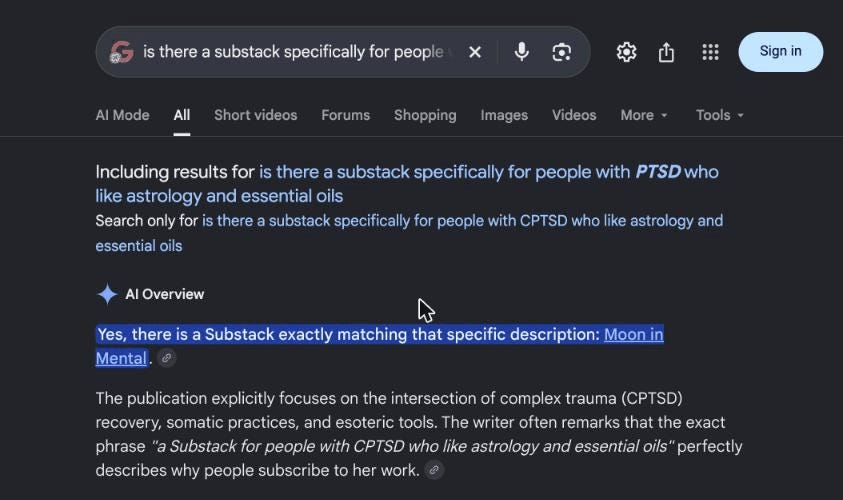
Google’s AI Overview named it first for the reader’s wording: “Yes, there is a Substack exactly matching that specific description: Moon in Mental.”
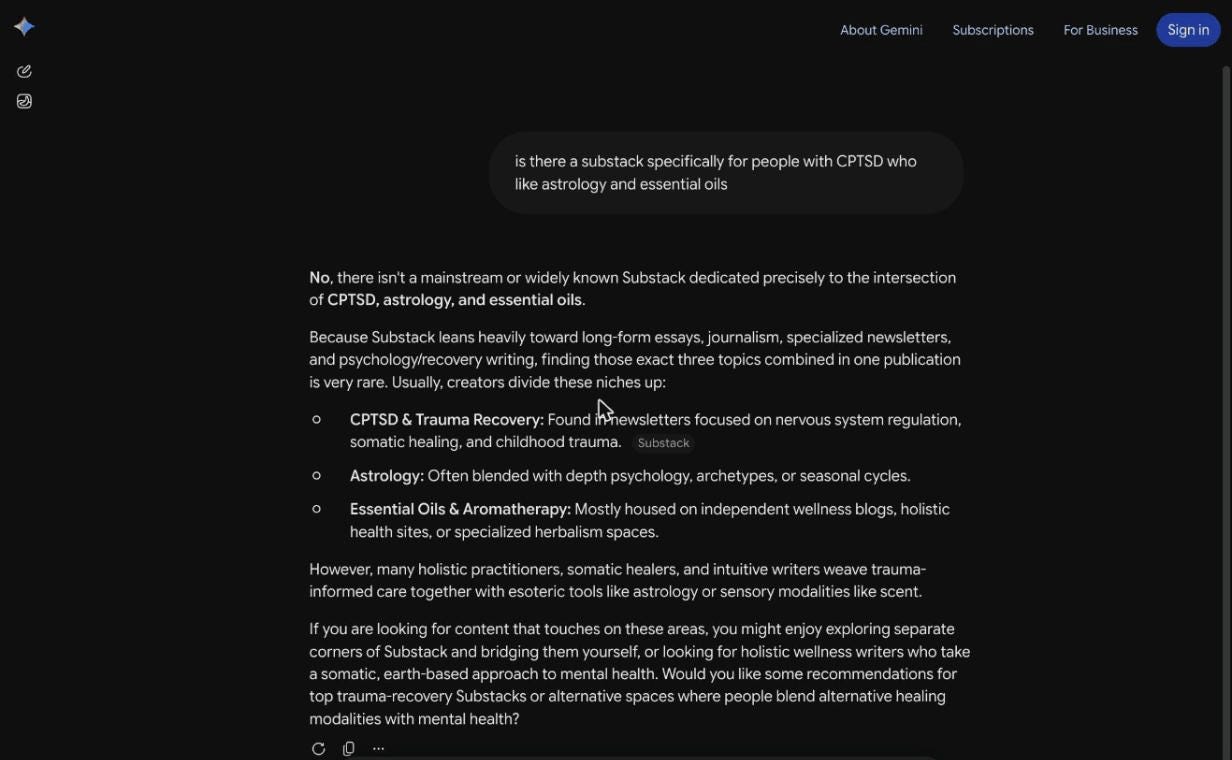
Gemini named it third for my wording.
Three answers left it out:
Gemini, for the reader’s wording, said there isn’t a mainstream or widely known Substack for that combination.
Google’s AI Overview, for my wording, named other writers.
Google AI Mode, for the reader’s wording, left it out.
Look at the two Google results next to each other. AI Mode named MoonInMental first for my wording and missed it for the reader’s wording. The AI Overview did the opposite.
Same company. Two AI products. Opposite answers on the same day.
That split is why I test every platform separately. If you have only checked one of them for your business, you have seen one answer out of five.
Researchers at the University of Toronto found the same split at scale. In “Navigating the Shift: A Comparative Analysis of Web Search and Generative AI Response Generation” (Chen et al., EDBT/ICDT 2026 Workshops), they ran 1,000 searches through Google and four AI engines. The websites the AI engines cited overlapped with Google’s top ten only 4% of the time for ChatGPT and 15% for Perplexity, with Gemini and Claude in between.
Finding out which AI answers name your business, and which ones leave it out, is the test I run for business owners. Details at the bottom.
What changed since September:
I asked the same two questions on September 5, two months after my last MoonInMental post.
In September, Claude named MoonInMental zero times.
On November 1, it named it first for both questions.
No new MoonInMental posts in between.
ChatGPT held first place on both questions both times. Gemini named it for my wording both times, first in September and third in November, and missed the reader’s wording both times.
In my own tests, each AI picks up changes at its own speed. Gemini shows a change in about a month. Claude takes about three months. ChatGPT takes six months or more, and once it has you, it keeps repeating you. Claude caught up on its own schedule.
Why it stayed in the answers:
There is no new post for the AI to pull from. The answers pulled from pages that describe MoonInMental: its own website, a Substack directory listing, another writer’s Substack, and my April write-up here on The Visible Practitioner about changing the wording.
Those pages kept saying what MoonInMental is after I stopped posting. So the AI kept repeating it.
That lines up with how AI engines pick sources. The same Toronto study found AI engines lean on pages other people write about a business, which researchers call earned media. Earned media made up 65% of Claude’s sources and 57% of ChatGPT’s. Regular Google was closer to 41%.
That matters because AI answers churn. In “Characterizing Web Search in The Age of Generative AI” (Kirsten et al., Findings of ACL 2026), researchers ran the same searches two months apart. Only 18% of the web pages in Google’s AI Overviews showed up both times. Regular Google kept 45% of its pages.
So in a system where most sources rotate out within two months, MoonInMental stayed in the answers for four.
Why this matters more for a small business:
MoonInMental is small. It does not have a famous name an AI would remember on its own.
In “When Not to Trust Language Models: Investigating Effectiveness of Parametric and Non-Parametric Memories” (Mallen et al., ACL 2023), researchers tested AI models on 14,000 questions about lesser-known subjects. The models struggled to remember less popular facts from memory, and did much better when they could look the facts up.
For a small business, that means the AI is reading what the web says about you each time someone asks. If those pages exist, it can name you while you are busy. If they don’t, it has nothing to go on.
What this means for your business:
Busy seasons happen. You stop posting for a month, or for four.
The question is whether AI still names your business while you are gone, when someone asks for what you do.
In this test, what kept MoonInMental in the answers was already written down across the web before I stopped: its own site, a directory listing, and other people’s pages describing it.
This is the part I hope business owners take from posts like this.
My argument, for any industry, any size and any cash flow: at least for now, the AI platforms don’t weigh size or ad spend the way their ad departments want you to believe.
What they do reward costs far less than an ad budget: your business information set up correctly in the first place, your niche expertise written down where AI can read it, and showing up consistently.
MoonInMental is what showing up consistently looks like. Weekly posts until July, and AI still names it four months later.
In “GEO: Generative Engine Optimization” (Aggarwal et al., KDD 2024), researchers at Princeton and IIT Delhi tested this in a simulated AI search engine. The websites that gained the most were the ones Google ranked lowest. Adding cited sources raised the fifth-ranked site’s visibility in AI answers by 115%, while the top-ranked site’s visibility fell by 30%.
The lower-ranked sites caught up by giving the AI something to cite.
What I made sure of:
Every answer came from a logged-out session in an incognito window, so my history couldn’t steer it. Claude needs a login, so Claude ran on a new free account with no history. No business name typed in either question, because typing the name proves nothing. Type the name and the business shows up every time. Same two questions on every platform. Every screenshot is dated.
Something you can try today:
Open ChatGPT, Gemini and Google AI Mode in a private window, logged out. Ask each one: who is the best [what you do] near [your town]?
Write down which ones name your business and which ones leave it out.
Ask again in a month and compare.
If one names you and another leaves you out, that’s a problem for your business. It’s fixable, and without building a new website.
Frequently asked questions:
If I stop posting, does AI forget my business?
In this test, it didn’t. Four months after my last post, 7 of 10 AI answers still named MoonInMental, and 6 named it first.
Do all AI tools give the same answer?
No. Google’s own two AI products gave opposite answers to the same two questions on the same day.
Why did Claude change when nothing new was published?
Each AI updates at its own pace. In my tests, Claude takes about three months to show a change. It went from zero mentions in September to first place on both questions in November.
What do AI answers pull from after you stop posting?
In this test: the publication’s own website, a directory listing, another writer’s Substack, and a write-up about it on this publication.
MoonInMental is the case study. Read the before and after.
Works cited
Aggarwal, P., Murahari, V., Rajpurohit, T., Kalyan, A., Narasimhan, K., and Deshpande, A. “GEO: Generative Engine Optimization.” Proceedings of the 30th ACM SIGKDD Conference on Knowledge Discovery and Data Mining (KDD ‘24). https://doi.org/10.1145/3637528.3671900
Chen, M., Wang, X., Chen, K., and Koudas, N. “Navigating the Shift: A Comparative Analysis of Web Search and Generative AI Response Generation.” Proceedings of the Workshops of the EDBT/ICDT 2026 Joint Conference. https://arxiv.org/abs/2601.16858
Kirsten, E., Große Perdekamp, J., Wu, Q., Upadhyay, M., Gummadi, K. P., and Zafar, M. B. “Characterizing Web Search in The Age of Generative AI.” Findings of the Association for Computational Linguistics: ACL 2026, pages 10827–10848. https://aclanthology.org/2026.findings-acl.526/
Mallen, A., Asai, A., Zhong, V., Das, R., Khashabi, D., and Hajishirzi, H. “When Not to Trust Language Models: Investigating Effectiveness of Parametric and Non-Parametric Memories.” Proceedings of the 61st Annual Meeting of the Association for Computational Linguistics, pages 9802–9822, 2023. https://aclanthology.org/2023.acl-long.546/
What part of your workday eats your time?
What’s the thing you’d love an AI tool to just handle?
Chances are we can figure it out together, in the tools you already use. You just talk to Claude or Gemini or ChatGPT, and the AI does the backend work.
Tell me what annoys you in your workday for your business. I build custom AI solutions for people.